Tuesday 20 January 2026

William White - The centuries of revolution


William White - The centuries of revolution

Dedication
This book is dedicated to the hundreds of millions murdered, tortured and raped by the advocates of Democracy, Communism and Zionism.
WILLIAM WHITE


Preface
The world turned upside down. illWhite likes nothingmore than to challenge authority. Often to his sorrow. In this book Bill challenges authority, all right. And he does so to his complete satisfaction, if not mine.
Here, Bill turns the world upside down. For haven’t we all been taught from infancy that we live in a world of escalating progress ? A world of constant improvement, demonstrated by automobiles, the availability of electricity, washing machines, television, porn-on-demand, bigger bombs to killmore people, larger warships, faster airplanes-unmanned drones to kill enemiesmore efficiently-even space ships to bring our “civilization” to aliens. Our masterminds can even out-guess God and change the weather. Wow !
But Bill is skeptical. This isn’t progress at all, he says. No, we are not evolving to sainthood, we’re devolving.We’re going down, not up.We’re knocking on Satan’s door.
What ! That’s heresy. That’s contrary to everything we have been taught, everything we’ve observed, our own experience.
But we’re wrong. I’ve read this book and Bill is right. In a word, the human race is going to Hell.
Of course, Bill may be crazy and so may I. You are going to have to read this book before judging who is nuts-the world, you and me-or BillWhite.
WILLIS A. CARTO - February 2012


Communism - PDF
Revolution - PDF

Saturday 17 January 2026

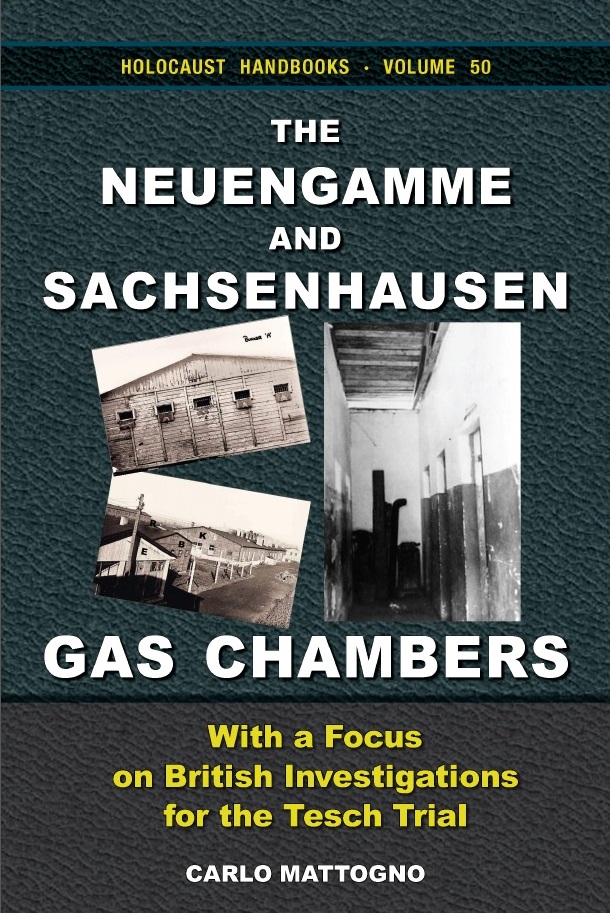
Carlo Mattogno - The Neuengamme and Sachsenhausen gas chambers


Carlo Mattogno - The Neuengamme and Sachsenhausen gas chambers


The evaluation of many interrogation protocols exposes inconsistencies, discrepancies and contradictions. British interrogating techniques are revealed as manipulative, threatening and mendacious. Finally, technical absurdities of gas-chambers and mass-gassing claims unmask these tales as a mere regurgitation of hearsay stories from other camps, among them foremost Auschwitz.

Carlo Mattogno - PDF
Revisionism - PDF

A major challenge for critical historical researchers is access to archival materials in European countries that dictate by penal law the results of research into the history of the Third Reich. If a well-known critical historian were to show up in such an archive and ask for access, he would be arrested.
Thank God, however, that there are a few conscientious established historians who have some backbone and help us critical researchers unofficially and out of sight of law enforcement by providing us with otherwise inaccessible archival material.
In the present case, Carlo Mattogno was given access to archival materials in England and in Germany concerning criminal proceedings conducted by those two countries after the war on alleged events at the Neuengamme and Sachsenhausen Concentration Camps. Of primary interest here are allegations of homicidal gassings in camp buildings converted or misappropriated for this purpose. The evaluation of many interrogation protocols and court testimonies shows that, as the number of statements increases, so do their discrepancies and contradictions.
Particularly illuminating is the way in which British interrogators proceeded in the British Occupation Zone in post-war Germany. Every incriminating statement made by former camp inmates was regarded from the outset as incontrovertible truth. If this “truth” was not confirmed by other witnesses, the interrogators used threats, blatant lies and misleading statements to confuse and trick these recalcitrant witnesses into giving false testimony.
A discussion of the technical absurdities that accompanied the gassing stories about Neuengamme and Sachsenhausen at every turn rounds out this work.


armreg.co.uk

Saturday 10 January 2026

Miklós Nyiszli - Carlo Mattogno - An Auschwitz doctor's eyewitness account


Miklós Nyiszli - Carlo Mattogno - An Auschwitz doctor's eyewitness account
The bestselling tall tales of Dr. Mengele’s assistant analyzed


Nyiszli, a Hungarian physician, ended up at Auschwitz in 1944 as Dr. Mengele’s assistant. After the war he wrote a book and several other writings describing what he claimed to have experienced. To this day some traditional historians take his accounts seriously, while others reject them as grotesque lies and exaggerations.
This study presents and analyzes Nyiszli’s writings and skillfully separates truth from fabulous fabrication.

Carlo Mattogno - PDF
Revisionism - PDF

Everyone knows Dr. Josef Mengele, the evil Auschwitz doctor who sent countless Jews to the gas chambers, performed cruel, pointless medical experiments on inmates, and gave twin research a bad reputation. But how do we “know” about his many diabolical deeds ?
The most important source for what Mengele is said to have done at Auschwitz comes from the Hungarian Jew Miklós Nyiszli, a forensic physician who claims to have been Dr. Mengele’s assistant at Auschwitz. In 1946, he published a book about his traumatic experiences while he was at Auschwitz. Over the years, his book has been translated into all major languages of Europe. It has become one of the mainstays of the orthodox Auschwitz narrative, right next to the testimonies of other key witnesses, such as that of the former Auschwitz commandant Rudolf Höss, or of Elie Wiesel.
As influential as Nyiszli’s book has been in forming the world’s opinion about Auschwitz, Nyiszli’s various writings have never been subjected to thorough critical scrutiny. The present book changes this.
Part 1 of this book contains a faithful translation of the original 1946 edition of Nyiszli’s Hungarian book, while Part 2 makes publicly accessible for the first time essential excerpts of much-less known postwar texts by and about Nyiszli.
Part 3 thoroughly scrutinizes Nyiszli’s writings with what we know to be true about Auschwitz from solid material facts and authentic documentation, while Part 4 compares his various claims with what other inmate doctors have stated who were in a similar position at Auschwitz as Nyiszli claims for himself.
Part 5 takes a critical look into how orthodox historians have dealt with Nyiszli’s texts, while a short essay in the Appendix lays bare the mythical nature of the cliché of Dr. Mengele as the “Angel of Death.”

The author’s conclusion is dispositive : Nyiszli was either an extraordinary impostor or a lunatic; there is no escaping from the dilemma. And both horns of this dilemma – shameless mendacity or lunacy – disqualify Nyiszli and completely destroy his credibility.

https://armreg.co.uk

Thursday 27 November 2025

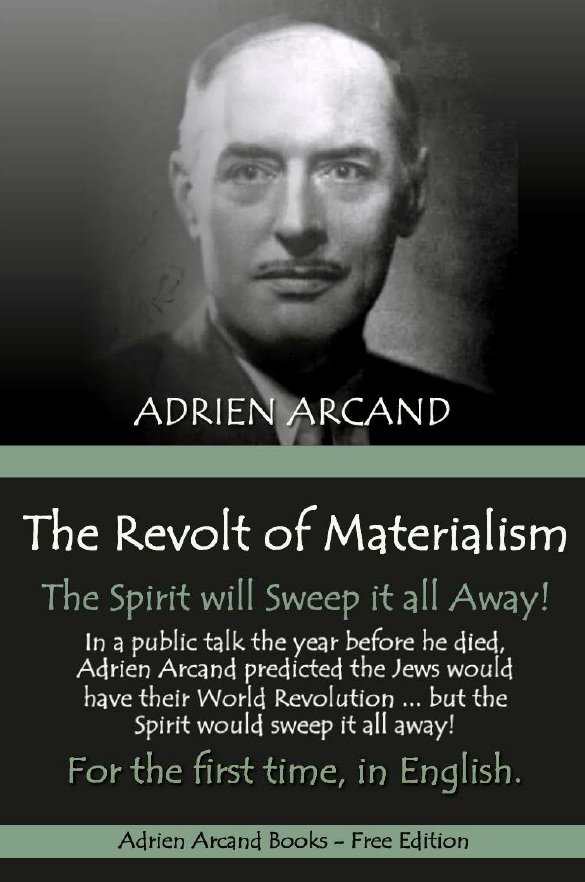
Adrien Arcand - The revolt of materialism


Adrien Arcand - The revolt of materialism


The Revolt of Materialism appears to be the sequel to another talk by Adrien Arcand that same year, 1966. In “Communism Installed Here”, Arcand says: “I will tell you soon how this colossal apparatus of conspiracy against the human being will collapse, amidst the greatest cacophony of creakings, crepitations and moanings that our planet has ever heard”.
In The Revolt of Materialism, published the year before he died, Arcand makes a victorious closing statement to all of his work. He gives a last warning to those who still believed then (and who believe today) that they have defeated the Spirit.
Adrien Arcand left us an ultimate legacy : his assurance that the Communist enemy will not prevail ; that the enemies of humanity, who oppress and persecute, have made their downfall inevitable by their own violations of the human spirit and Natural Law.


Adrien Arcand - La révolte du matérialisme
Adrien Arcand - PDF


Sunday 16 November 2025

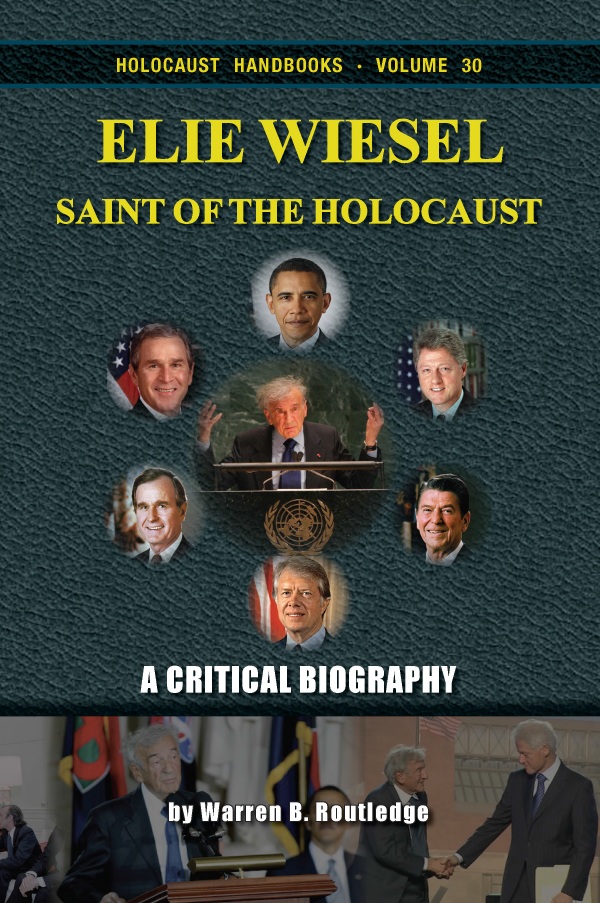
Warren B. Routledge - Elie Wiesel Saint of the holocaust


Warren B. Routledge - Elie Wiesel Saint of the holocaust
A critical biography


Introduction
The present study seeks to accomplish several goals simultaneously. Written both for non-revisionists interested in learning more about Holocaust revisionism and its relationship to the Jewish Holocaust Story of World War II, as well as revisionists of various information levels, the work does not presume any prior knowledge. Its first objective is to provide the reader with a general, introductory overview of the revisionist movement, including its main arguments, key players, and historiographical achievements. The study covers the period from the 1960s to the year 2010, and its purpose is not only to bring forth new revisionist arguments and information, but also to summarize and contextualize the accomplishments of the leading revisionist scholars. The terminus date of 2010 was selected because the close of the first decade of the twenty-first century corresponds roughly to a half-century of revisionist activity. The book’s second goal is to tell the story of the emergence and blossoming of Holocaust revisionism within the context of Elie Wiesel’s life and career.
His name has become synonymous with the Holocaust, and not a few people have called him the “Holocaust High Priest.” Indeed, the vast majority of Holocaust devotees (both Jews and non-Jews) look upon him as a holy man of sorts, in part because of his supposedly miraculous survival at Auschwitz and Buchenwald, but also because of the key role he played in the founding of the U.S. Holocaust Memorial Museum in Washington, DC.
An additional benefit of this approach is that, by telling the revisionist story in the context of Wiesel’s career, I have been able to add the theme of “Catholic- Jewish Dialogue” to the mix. This is so because Wiesel’s greatest benefactor from the very beginning of his career was the French Catholic novelist, man of letters, and Nobel Prize winner François Mauriac (1885-1970). Mauriac “discovered” Wiesel, helped him to get his first book, the supposedly autobiographical La Nuit (1958), published in Paris, and wrote a flattering review of it when no one else seemed interested in it. He also had a very close personal attachment to Wiesel until his death in 1970.Their relationship is connected to another of the present study’s themes: the problematic and at times abusive relationship that has existed between the various international Jewish organizations and media outlets on the one hand, and the men who served as Pope of the Catholic Church from Pius XII to Benedict XVI. In exploring this latter theme, I document and analyze the subversive role played by various Catholic “Holocaustians.” Such men and women, nominally Catholics, often advance their careers in Zionist media or academic environments by claiming, without proof and to various degrees, that Pius XII and the Catholic Church as a whole somehow bear “guilt” for the Holocaust. It is a very cynical and mendacious game, but it pays quite well. The discussion of their activities, coupled with the surrender of the popes to the Zionist agenda, adds further insight into the reasons for the incredible and unprecedented decline of the Catholic Church over the past half century in every imaginable way.
While Holocaust revisionism is a truly international movement in which citizens of many nations are involved to varying degrees, the special focus here is on revisionism in France and the United States. In France, Professor Robert Faurisson has been the unquestioned leader in the effort for the past four decades. In the U.S., however, there has been a succession of actors over the years. From the emergence of Professor Arthur Butz in the 1970s, to the Institute of Historical Review in the 1980s and beyond, to the work of Bradley Smith and his Committee for Open Debate on the Holocaust (CODOH) for the past thirty years, many hands have lent themselves to this work. With regard to Elie Wiesel, Carolyn Yeager’s blog site, “Elie Wiesel Cons the World,” has played an enormous role in recent years by bringing to light a great deal of valuable information about Wiesel. I hope that her work, and that of other revisionists, will continue to flourish.
This study is divided into three main sections. The first contains four chapters dealing with the Mauriac–Wiesel relationship and the genesis of his novel Night, while the second section’s two chapters offer a close critical reading of Wiesel’s novel. In the third section, I seek to combine my unauthorized biography of Wiesel with an overview of the development of historical revisionism in the U.S. (and to a lesser degree in Europe), from the appearance of Night in English in 1960 to 2010. These themes are presented chronically in order to give the reader a sense of how far revisionist arguments have advanced in a mere half-century of activity, as well as to document the inability of the Holocaustians to rebut them. I have also woven into this narrative the related issues of the abandonment of Pius XII by the post-Conciliar Catholic Church, and the negative reaction among many Jews to both Wiesel and the Holocaust narrative in general. While this ambitious, but focused, narrative might seem disjointed at times to some readers, it does adhere to this general outline and seeks as much as possible to avoid repetitions.


Revisionism - PDF